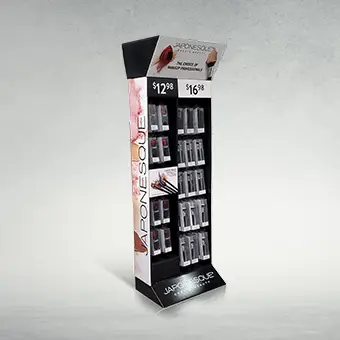

As eCommerce and digital shopping continue to grow, many retailers and brands are asking the same question:
Do in-store displays still matter?
The answer is yes, as customers are looking for more than just products; they seek experiences. More than ever, the use of window displays is crucial in attracting shoppers to the retail store.
While consumers increasingly discover products online, physical retail remains one of the most powerful environments for conversion, impulse purchasing, and brand engagement. In fact, industry research consistently shows that a significant percentage of purchasing decisions are still made in-store, highlighting the importance of visibility and merchandising at the point of purchase.
At Bay Cities, we’re seeing this firsthand across retailers nationwide. At a recent industry event focused on shopper behavior and retail trends, one theme emerged repeatedly: brands that successfully connect digital discovery with physical retail experiences are winning. For brands competing in crowded retail environments, strategic displays are no longer just a merchandising too – they are a critical part of the shopper journey, often enhanced by the use of dump bins and clip displays.
In-Store Discovery Is Evolving
Today’s shoppers don’t interact with retail environments the same way previous generations did, particularly with the rise of unique display options. Gen Z consumers, in particular, are reshaping how physical retail functions, often influenced by innovative floor designs and displays.
While younger shoppers often discover products through TikTok, Instagram, YouTube, and influencers, that digital discovery frequently leads to an in-store purchase, where engaging retail space plays a crucial role. In fact, a recent impact.com consumer survey found that nearly half of shoppers finalize their purchases instore after conducting research online. What The research mirrors what we’re seeing at Bay Cities – that is that retail environments are increasingly becoming a place of validation and exploration. Consumers may arrive with awareness of a product, but a well-executed display can be the factor that ultimately drives conversion.
The research mirrors what we’re seeing across the programs Bay Cities executes. Retail environments are increasingly becoming a place of validation, exploration, and immediate gratification, driven by effective merchandising strategies. Consumers may arrive with awareness of a product, but a well-executed display can be the factor that ultimately drives conversion by making the product easy to find, easy to understand, and easy to purchase.
Convenience stores are a perfect example of how effective shelving can enhance the shopping experience. Once viewed primarily as a destination for necessity purchases, many are evolving into discovery-driven environments where shoppers browse for new products, limited-edition offerings, and trending snacks.
According to GSTV Insights, 92% of Gen Z consumers say they enjoy browsing convenience stores, reinforcing the idea that these locations have become much more than a quick stop for fuel or essentials, thanks to engaging pop displays.
For brands, this presents a significant opportunity.
Convenience stores have become a low-risk environment for trial, where shoppers are open to discovering something new, and the purchase commitment is relatively small, often facilitated by eye-catching signage. We’ve seen retailers and brands increasingly leverage eye-catching displays, seasonal programs, and cross-category merchandising to capitalize on these moments of discovery.
Retail environments now serve as a bridge between digital awareness and physical conversion, making strong in-store execution, effective merchandising strategies, and impactful signage more important than ever.
Displays Influence Shopper Decisions Quickly
Today’s shoppers are overwhelmed by choice. Whether they are walking a grocery aisle, club store, drug store, or convenience channel, brands have only a few seconds to capture attention.
Whether they are walking a grocery aisle, club store, drug store, or convenience channel, brands have only a few seconds to capture attention through impactful displays and engaging retail space.
This is where countertop displays become incredibly valuable.
At Bay Cities, we’ve seen firsthand how strategically placed displays and engaging signage can help brands increase visibility, encourage impulse purchases, and create destination shopping experiences. In many categories, the challenge is no longer product awareness—it’s winning attention in a crowded retail environment, where effective signage and strategic fixtures are key.
Displays help solve that challenge by interrupting the shopping journey and creating a reason to engage with featured items.
This is especially true in categories like sweets and snacks, where seasonal programs and occasion-based merchandising often outperform traditional shelf placement.
Industry experts at the event noted that when snacks and confectionery products are featured on displays, they consistently outperform many adjacent categories, thanks to effective marketing hooks and strategic fixture placement. We’ve observed similar results through programs executed for retailers nationwide, particularly around seasonal events such as Halloween, Valentine’s Day, Back-to-School, and the Super Bowl, utilizing various display cases. In many cases, retailers are looking beyond category-specific merchandising and instead focusing on creating shopper destinations that support a larger occasion or mission using pop displays.
The reality is simple: if shoppers can’t easily see a product on the floor, they are far less likely to purchase it.
Why Cross-Category and Multi-Vendor Programs Work
One of the strongest trends we continue to see is the rise of occasion-based shopping. Consumers aren’t necessarily shopping for individual products—they’re shopping for moments. Whether it’s game day, movie night, back-to-school, holiday gifting, or summer entertaining, shoppers are looking for solutions that simplify decision-making and help them choose the right products to bring an occasion to life.
This is where cross-category merchandising becomes especially effective in creating an engaging shopping space.
At Bay Cities, we’ve long believed that the most successful retail programs don’t simply merchandise products—they merchandise occasions. By bringing together complementary products from multiple categories into a single destination, retailers create a more intuitive shopping experience while increasing basket size and driving incremental sales.
As one of the industry’s leaders in multi-vendor pass-through programs, Bay Cities specializes in coordinating complex retail executions that bring together multiple suppliers, product categories, and retail objectives into a single merchandising solution.
These programs require far more than display cases and design; they necessitate effective use of retail space and engaging fixtures. They demand supplier coordination, inventory management, logistics planning, fulfillment expertise, retailer compliance, and flawless execution.
Because Bay Cities manages the entire process—from supplier procurement and inventory aggregation to packout, fulfillment, routing, and distribution—we help retailers simplify execution while creating a seamless shopping experience for consumers. This pre-aggregated approach reduces store-level labor, supports faster replenishment, and creates a true one-stop destination for shoppers by optimizing the item selection and display system.
One example is a national program we executed that brought together 21 suppliers, 286 unique SKUs, and more than 10 million products into a single retail execution across approximately 2,800 stores. By creating a one-stop destination for shoppers, retailers were able to simplify the purchase journey while participating brands benefited from increased visibility and incremental sales through well-placed racks.
As major retail events continue to overlap – such as the upcoming convergence of Valentine’s Day and the Super Bowl in 2027 – cross-category merchandising will become even more important in optimizing retail space. Consumers will increasingly expect retailers to help them shop occasions rather than individual categories.
How Bay Cities Helps Brands Win at Retail
As a preferred vendor to many of the nation’s leading retailers, Bay Cities brings deep expertise in retailer requirements, in-store execution, supply chain coordination, and multi-vendor merchandising programs. We support brands through every stage of the retail journey—from initial concept and visualization through manufacturing, fulfillment, transportation, and retail deployment.
Our ability to execute large-scale retail programs is supported by extensive packout and fulfillment operations, nationwide logistics capabilities, retailer relationships, and decades of experience managing complex retail initiatives. Whether supporting a seasonal display rollout, a retailer-exclusive launch, or a multi-vendor pass-through program, our focus remains the same: helping products stand out at retail and drive sales.
Because we support programs across major retailers nationwide, we have a unique perspective on how shopper behavior continues to evolve. And one thing remains consistent: visibility drives conversion.
Frequently Asked Questions
Why are in-store displays still effective?
In-store displays increase visibility, drive impulse purchases, and help products stand out in crowded retail environments, especially when utilizing strategic fixtures and signage.
What is omnichannel merchandising?
Omnichannel merchandising creates consistent shopping experiences across digital and physical retail channels, ensuring that display cases are utilized effectively in both realms.
How do retail displays increase impulse purchases?
Displays improve product visibility, simplify shopper decision-making, and encourage unplanned purchases through effective merchandising strategies.
Why are convenience stores important for Gen Z shoppers?
Gen Z consumers increasingly visit convenience stores for discovery, experimentation, and social experiences, often seeking out new items in unique spaces.
What are multi-vendor retail programs?
Multi-vendor programs combine products from multiple brands into one retail display or merchandising experience, often utilizing dump bins and clip displays to enhance visibility.
Why is seasonal merchandising important?
Seasonal merchandising helps brands align products with key shopping occasions and increases shopper engagement during high-traffic periods.
In-store displays increase visibility, drive impulse purchases, and help products stand out in crowded retail environments.