Super Bowl LXI and Valentine’s Day collide on February 14, 2027. For brands and retailers, the opportunity isn’t simply to market around two major occasions at once. It’s to rethink how products, categories, and brands can come together at retail.
On February 14, 2027, shoppers will have two very different reasons to celebrate.
Super Bowl Sunday is built around watch parties, food, snacks, beverages, and shared experiences. Valentine’s Day is synonymous with gifting, candy, flowers, and meaningful connections.
In 2027, they happen on the same day.
The convergence—already being dubbed “SuperVal”—creates what Confectionery Production calls an “unusual prime retailing opportunity.” More importantly, it compresses two traditionally distinct shopping missions into one high-intensity retail window.
For brands and retailers, that raises a bigger strategic question:
What if the best way to win SuperVal isn’t to choose between game day and Valentine’s Day but to merchandise them together?
That is where cross-category merchandising and multi-vendor retail programs can turn an unusual calendar event into a differentiated shopper experience—and a significant opportunity to increase basket size, simplify execution, and win at retail.
What Is SuperVal 2027?
SuperVal 2027 refers to the rare convergence of Super Bowl LXI and Valentine’s Day on Sunday, February 14, 2027.
Super Bowl LXI will be played at SoFi Stadium in Los Angeles, putting an additional spotlight on an already major retail event. For the first time, brands will need to consider game-day and Valentine’s Day shopping behaviors simultaneously rather than as two separate seasonal campaigns.
Research from the National Confectioners Association (NCA) suggests consumers are ready for exactly that.
According to NCA research:
- 87% of consumers celebrate Valentine’s Day some or all years.
- 83% watch the Super Bowl some or all years.
- 7 in 10 plan to participate in both occasions.
- 48% expect to shop for both occasions at the same time.
- 75% welcome ideas for creatively combining the two occasions.
That last number may be the most important for retailers and brands.
Shoppers aren’t simply tolerating the collision. Many are open to retailers helping them navigate it.
One Shopping Trip. Two Missions. A Bigger Retail Opportunity
The Super Bowl and Valentine’s Day have traditionally created different purchase missions.
A Super Bowl shopper might reach for chips, dips, beverages, candy, party supplies, or team merchandise. A Valentine’s shopper might be searching for chocolates, flowers, cards, beauty products, jewelry, or other gifts.
On February 14, 2027, those missions converge.
NCA’s research found that 48% of consumers expect to shop for both occasions at the same time, creating a natural opening for retailers to reduce friction by helping shoppers solve multiple needs in one destination.
Industry reporting has similarly highlighted the potential for shoppers to purchase shareable game-day products alongside seasonal gifting items, creating more complex purchasing behavior and potentially higher-value baskets.
That changes the merchandising opportunity.
Instead of asking:
Where should we put the chips? Where should we put the chocolates? Where should we put the party supplies?
Retailers and brands can ask:
How can we create one destination that helps shoppers celebrate the entire day?
Why Cross-Category Merchandising Makes Sense for SuperVal
Bay Cities has been watching a broader retail shift toward solution-based, cross-category merchandising.
Today’s shoppers are increasingly intentional. That puts pressure on brands and retailers to create displays that communicate value quickly, inspire discovery, and make complementary purchases intuitive.
Cross-category programs can do exactly that by bringing products together around a shopper need rather than keeping them confined to traditional category silos. Bay Cities has identified multi-vendor programs as one way retailers can create these connected experiences while driving incremental sales, improving sell-through, and reducing execution challenges with store-ready displays.
SuperVal may be the ultimate test case.
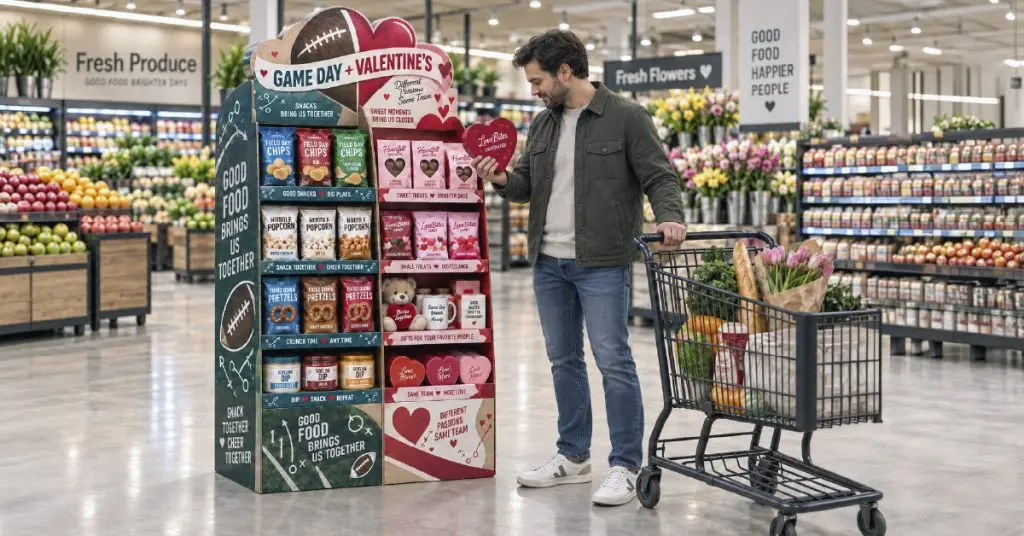
Imagine a retail destination built around “Game Day + Date Night.”
One cohesive display could bring together:
- Shareable snacks and candy
- Chocolate and gifting
- Beverages
- Party supplies
- Flowers or gifting accessories
- Beauty and personal care
- Entertainment or electronics accessories
- Licensed merchandise
- Other complementary categories
The point isn’t simply to put unrelated products on the same pallet.
The opportunity is to build a shopper-led solution around how people will actually experience February 14.
Research firm Zappi makes a similar observation: despite their differences, the Super Bowl and Valentine’s Day share emotional territory around celebration, relationships, and bringing people together. That gives marketers permission to build experiences around connection rather than forcing shoppers to choose between football and romance.

From Product Display to Retail Destination
This distinction matters.
A display holds products.
A retail destination solves a shopper mission.
For SuperVal, brands have an unusual opportunity to move beyond their individual category and participate in something bigger. A snack brand doesn’t necessarily have to compete only within snacks. A confectionery brand doesn’t have to live exclusively in the Valentine’s aisle.
Together, complementary brands can create a visually unified destination built around the occasion itself.
That can help retailers inspire discovery while giving participating brands access to prominent event-driven retail space.
It also aligns with a larger change Bay Cities sees taking place in grocery and mass retail: retailers are increasingly looking for merchandising solutions that connect complementary brands, improve the shopping experience, and encourage shoppers to add related products to their baskets.
SuperVal gives retailers a particularly compelling reason to accelerate that strategy.
Why Multi-Vendor Programs Are Built for Moments Like This
The idea is exciting. Executing it across hundreds or thousands of stores is where things get complicated.
Multiple brands mean multiple products, timelines, suppliers, creative requirements, and inbound shipments—all of which eventually need to become one cohesive retail program.
That’s exactly the operational problem a multi-vendor programs is designed to solve.
Bay Cities’ multi-vendor pass-through programs bring multiple brands together within a single coordinated retail display. Bay Cities can manage the structural design, production, packout, retailer compliance, and distribution while coordinating participating vendors.
For retailers, these programs can create a turnkey, store-ready merchandising solution while reducing the operational burden at store level. For brands, shared retail real estate can provide access to event-driven visibility without requiring every participant to fund and execute an entirely separate custom program. Bay Cities’ capabilities materials also identify benefits including cross-category inventory, single-touch store execution, and an affordable participation model for manufacturers.
For SuperVal, that creates several possibilities:
One destination, multiple missions.
A coordinated display can address gifting, entertaining, and celebration simultaneously.
Cross-category discovery – Complementary products can appear together in a context that encourages shoppers to think beyond their original shopping list.
Shared investment – Participating brands can share the retail footprint rather than each building an independent activation.
Simpler store execution – Pre-aggregated, store-ready programs can reduce the number of individual components store teams need to receive, assemble, and merchandise.
A stronger shopper experience – Instead of navigating disconnected seasonal areas, shoppers encounter a solution built around the way they’re actually celebrating.
Winning SuperVal Will Require More Than a Great Display
The physical display is only the visible part of the program.
The harder work happens before it ever reaches the retail floor.
A cross-category activation has to coordinate products from multiple vendors, meet retailer specifications, maintain structural integrity, arrive within a narrow promotional window, and execute consistently across stores.
That is why Bay Cities’ approach goes beyond packaging and display production.
That integrated approach does more than keep a program on schedule. It gives brands greater flexibility when retail opportunities move quickly.
By connecting design, manufacturing, print, testing, packout, fulfillment, and logistics, Bay Cities helps reduce handoffs and keep complex retail programs moving from concept to store floor. That speed to market can give brands more room to respond when timelines shift, retailer opportunities emerge, assortments change, or an unexpected promotional window opens.
For an event like SuperVal, that flexibility matters. Brands may need to coordinate multiple partners, respond to retailer feedback, adjust assortments, or capitalize on opportunities that weren’t part of the original plan. A more connected supply chain makes it easier to move when the market moves.
The result isn’t simply a faster program. It’s greater optionality: more opportunities a brand can confidently pursue, more flexibility to respond to retail needs, and a better chance of getting the right activation into stores while the moment still matters.
That connectivity is supported by Bay Cities’ end-to-end capabilities, including concept and design, project management, manufacturing and print, ISTA testing, multi-vendor packout, fulfillment, logistics, and retail program management.
Bay Cities also has experience managing inbound and outbound tracking, high-volume kitting and assembly, inventory control, and multi-vendor retail display executions.
In other words, the display is the vehicle.
The business outcome is the story.
Bay Cities’ goal is to help brands launch faster, improve the shopper experience, solve operational challenges, increase sales, and navigate an increasingly complex retail environment—all in service of helping clients win at retail.
SuperVal Retail Ideas for Brands and Retailers
There is no single SuperVal execution that will work for every retailer or category. The strongest concepts will start with the shopper mission and work backward.
Some potential territories include:
Game Day + Date Night – Build a one-stop destination for shoppers trying to pull off both celebrations: party food and beverages on one side, gifting and treats on the other.
Love at First Bite – Connect snacks, candy, desserts, and beverages around the shared language of indulgence and celebration.
Love Your Team – Pair licensed or team-inspired products with snacks, beverages, candy and gifting items to create a broader fan destination.
The Ultimate Watch Party – Expand the traditional game-day display beyond food into party supplies, entertainment, gifting, and other products that help shoppers host the entire occasion.
Celebrate Your People – Valentine’s Day is no longer limited to romantic partners. Campaigns can celebrate couples, friends, families, coworkers and other relationships, giving a wider range of brands permission to participate in the occasion.
The common thread should be shopper relevance.
A successful SuperVal program should make the shopping trip easier, more engaging or more inspiring (i.e., not simply combine pink hearts and football graphics).
Why Brands Should Start Planning SuperVal Programs Now
Major retail activations are won long before the display hits the floor.
Retailer conversations, brand partnerships, assortment strategy, creative development, structural engineering, testing, manufacturing, packout, and distribution all take time, particularly when multiple suppliers are participating.
For major event programs, Bay Cities recommends beginning planning conversations 18–24 months ahead of the event to allow more time for retailer buy-in, creative refinement and production planning.
And the stakes extend beyond February 14.
Super Bowl LXI is part of an extraordinary period for event-driven retail in Southern California, with the LA28 Olympic Games following in July 2028. Bay Cities is already helping brands think strategically about how these world-stage events can translate into retail activation opportunities.
Brands that develop the right cross-category partnerships, retail relationships, and execution models for SuperVal may therefore be building capabilities they can carry into future event-driven programs.
The Brands That Win Won’t Just Show Up. They’ll Solve the Shopping Mission.
SuperVal 2027 is unusual because two massive cultural moments happen to share a date.
But the larger retail lesson extends well beyond February 14.
Consumers don’t necessarily shop according to category boundaries. They shop around needs, occasions, and experiences.
When retailers organize merchandising around those missions—and when complementary brands collaborate instead of competing for isolated pieces of the store—they can create experiences that are easier to shop, more relevant and more likely to inspire incremental purchases.
That’s the real opportunity behind SuperVal.
At Bay Cities, we’ve spent decades helping leading brands and retailers translate big ideas into programs that actually work at retail. Our multi-vendor expertise, retail knowledge, design capabilities, manufacturing, testing, packout, fulfillment, and logistics allow us to connect the creative idea to the operational execution required to bring it to life.
Because winning SuperVal won’t come down to who creates the most clever football-and-hearts graphic.
It will come down to who understands the shopper, creates the right retail experience, and executes it flawlessly.
That’s how brands win the moment.
And that’s how Bay Cities helps clients win at retail.
FAQ
When are the Super Bowl and Valentine’s Day in 2027?
Both Super Bowl LXI and Valentine’s Day fall on Sunday, February 14, 2027. Super Bowl LXI will be played at SoFi Stadium in Los Angeles.
What is SuperVal 2027?
SuperVal is a shorthand for the 2027 convergence of Super Bowl Sunday and Valentine’s Day. The overlap creates an unusual retail opportunity because shoppers will be buying for two major occasions during the same shopping window.
Why is SuperVal important for retailers?
NCA research found that 7 in 10 consumers plan to participate in both occasions, and 48% expect to shop for both at the same time. That creates an opportunity for cross-merchandising, bundled promotions and retail destinations that serve multiple shopping missions.
What is a multi-vendor retail program?
A multi-vendor retail program brings products from multiple brands together in one coordinated display or retail activation. Bay Cities can manage structural design, production, packout, retailer compliance, and distribution, helping turn multiple participating suppliers into one cohesive retail program.
How can brands cross-promote the Super Bowl and Valentine’s Day?
Bands can build campaigns around shared themes such as celebration, connection, entertaining, gifting, and togetherness. At retail, cross-category displays can combine complementary products for missions such as “Game Day + Date Night,” watch parties, gifting or hosting.
How does Bay Cities help brands execute multi-vendor programs?
Bay Cities combines retail expertise with design, manufacturing, print, testing, packout, fulfillment, logistics, and retail program management. That integrated approach helps brands and retailers coordinate complex programs, simplify execution and move from concept to the retail floor.
How early should brands plan a Super Bowl retail activation?
For major event programs, Bay Cities recommends beginning planning 18–24 months in advance when possible. Early planning creates more time for retailer alignment, creative development, testing, manufacturing, and coordinated execution.
Ready to get started? Contact us today.